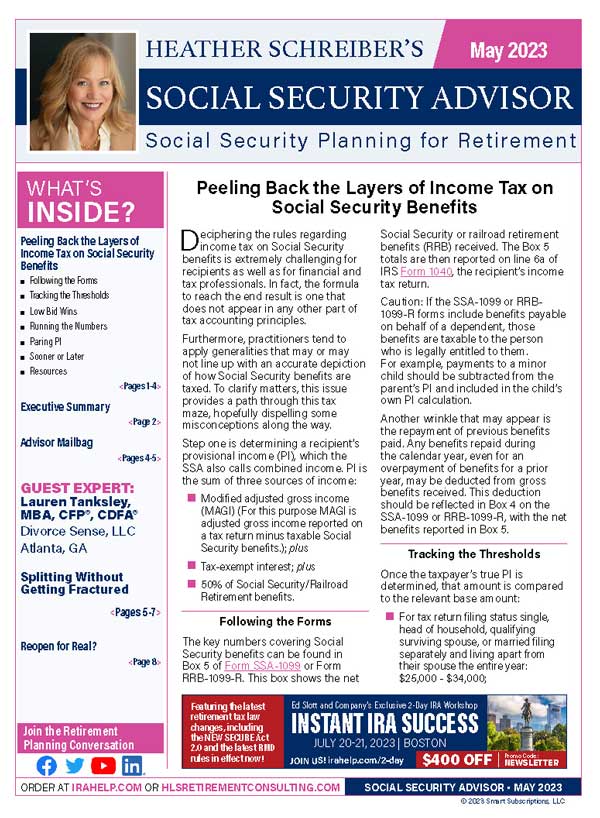
If your clients have been asking whether Social Security taxes are disappearing, you’re not alone. Headlines and social media have created the impression that benefits will soon be tax-free.
That’s not the case.
A new temporary tax deduction could provide modest relief for some older taxpayers beginning in 2025. But it does not eliminate the taxation of Social Security benefits, nor does it change the underlying rules that determine when benefits become taxable.
Understanding what changed will help you guide clients through the noise.
Are Social Security Taxes Being Eliminated?
No. The federal rules that determine whether Social Security benefits are taxable remain unchanged.
Under long-standing law, the taxable portion of benefits is determined using what the IRS calls “combined income.” Combined income is calculated as:
- Adjusted gross income (AGI)
- plus nontaxable interest
- plus one-half of Social Security benefits
This total is then compared to fixed thresholds:
| Filing Status | 50% Taxable Threshold | 85% Taxable Threshold |
| Single | $25,000 | $34,000 |
| Married Filing Jointly | $32,000 | $44,000 |
Depending on where the combined income falls, up to 85% of Social Security benefits may be subject to federal income tax.
Those thresholds have not changed, and neither has the formula used to calculate the taxable portion of the benefits.
What has changed is the introduction of a temporary additional deduction for older taxpayers.
What Is the New Senior Deduction?
Starting in the 2025 tax year, individuals age 65 or older can claim an extra $6,000 deduction ($12,000 for married couples filing jointly if both spouses qualify). Key aspects of this deduction include:
- Available whether taxpayers itemize or claim the standard deduction
- Temporary, scheduled to apply from 2025 through 2028
- Subject to income phase-outs
The deduction begins to phase out when modified adjusted gross income (MAGI) exceeds:
- $75,000 for single filers
- $150,000 for married couples filing jointly
For those who qualify, this deduction lowers taxable income, which may indirectly reduce the amount of Social Security benefits that are taxed. However, it’s also important to understand what it does not do.
What This Deduction Does Not Do
The new deduction has been widely misunderstood. It does not:
- Eliminate the taxation of Social Security benefits
- Change the combined income formula used to determine taxation
- Remove the requirement to report taxable benefits on a federal tax return
- Adjust the long-standing $25,000 / $32,000 income thresholds
It also does not reduce income for Medicare IRMAA purposes, because Medicare premium surcharges are based on modified adjusted gross income calculated before deductions.
In other words, the deduction may lower a retiree’s taxable income, but it does not change the underlying mechanics of how Social Security benefits are taxed. And because it is scheduled to expire after 2028, it should not be viewed as a permanent solution.
The Real Opportunity: Coordinating Retirement Income
The taxation of Social Security benefits largely depends on how retirement income is structured. Which accounts clients withdraw from, when they withdraw funds, and how those withdrawals interact with Social Security benefits can significantly influence the amount of benefits that are taxed. Some planning strategies worth considering include:
- Roth conversions: Strategic conversions before or early in retirement may help reduce future taxable income and manage the taxation of benefits.
- Qualified Charitable Distributions (QCDs): For clients age 70½ or older, directing IRA distributions to charity can satisfy RMDs without increasing taxable income.
- Tax-efficient withdrawal sequencing: Coordinating withdrawals across taxable, tax-deferred, and Roth accounts can help control overall income.
- Thoughtful claiming decisions: the timing of Social Security benefits can interact with other retirement income sources and impact the overall tax situation.
The Bottom Line
The temporary senior deduction is a useful tool that can assist some clients over the next few years. However, it is not permanent and is not a substitute for proper tax planning. The real work begins when you review their complete financial picture and strategically coordinate income sources.
Heather’s Hitting the Road!
Join us at the 2nd annual Horizons 2026, hosted by the American College of Financial Services, from May 4-6th in Orlando. Heather Schreiber will be among the nation’s leading thought leaders in retirement income planning, sharing insights into the latest research, strategies, and future trends in retirement planning.
Click here to learn more and register online!
Want more client-ready talking points delivered to your inbox?
Subscribe to Retirement Strategy Report, my free newsletter for advisors who like their strategies sharp and their clients sleeping soundly.

As Founder and President of HLS Retirement Consulting, she partners with forward-thinking advisors nationwide to design strategy-based solutions that help clients grow, protect, and preserve their retirement income. She also serves as Editor-in-Chief of Heather Schreiber’s Social Security Advisor, a nationally distributed monthly newsletter focused on turning complex Social Security rules into strategy-driven, value-creating solutions that help advisors strengthen relationships, retain clients, and drive growth.
Off the clock, Heather is a hiker, humorist, and proud matriarch of a family of six (plus four furry sidekicks). Having recently joined the ranks of America’s 63 million family caregivers, she shares her own caregiving journey through her writing, offering empathy, perspective, and hard-won lessons to others walking a similar path. Her signature blend of technical expertise, human connection, and a touch of sass makes her a trusted voice for advisors guiding clients through life’s most important financial transitions.
Click here to sign up for the Retirement Strategy Report, Heather’s free monthly newsletter for financial professionals.
- The Savings Game: Social Security regulations are complex - July 23, 2026
- What Is IRMAA and How Can You Avoid Paying More for Medicare? - July 13, 2026
- Why Social Security Should Be Part of a Holistic Retirement Income Plan - July 12, 2026